
Columnists
You Don’t Export to Germany; You Build Systems There

Onur Kurtay | Founder of Nexon Global Strategy Office
Germany is the country to which Turkey exports the most. This fact hasn’t changed for years. The volume is growing, and the numbers are rising. However, the same cannot be said on a structural level.
Despite this volume, many companies in Turkey are still talking about how to make sales rather than how to work with Germany. And that is precisely where the real turning point begins.
Exporting to Germany is usually structured in Turkey as follows:
- Find the right customer
- Offer a competitive price
- Send a sample
- Wait for the order
This model may work—but it is not sustainable.
Engineering and Technology
Germany is not a market for initial orders. Germany is a market of continuity. And continuity is not created through sales, but through a system.
In the organizations we sit down with, we observe the same reflex: the expectation of quick results. “Let’s jump in, get started, and we’ll fix the rest later.” This approach may work in Turkey, but it does not work in Germany.
We say it time and time again: in this market, speed is not the advantage—stability is. Notes are taken, but internal transformation remains slow. That’s because the majority of companies still don’t make a clear distinction: running operations is not the same as building a system.
Strategic Planning
When the German side places an initial order, they aren’t really making a decision yet. They are testing.
- Are the processes repeatable?
- Is delivery consistent?
- Is communication standardized?
- What is the reflex when a problem arises?
All of this is evaluated. Most of the time, the issue isn’t the product or the price. The problem is this: the company’s structure cannot handle these tests.
Looking at the industries doing business with Germany makes the picture even clearer. Take the automotive supply industry, for example. Companies in this sector working with Germany are significantly more disciplined compared to other industries. They are forced to be.
Geographical References:
- Delivery dates are non-negotiable
- There is zero tolerance
- Deviations from the standard are unacceptable
The most critical point: a single defective part can end not just that specific order, but the entire supply relationship.
That’s why companies in this sector learn early on: export is not selling; it is a system.
We don’t see the same approach in other sectors. Whether in textiles, food, or general trade, the prevailing mindset is still: “The product is good, the price is good, so it will sell.”
Sales
In Germany, however, this equation falls short. On this market, you don’t buy the product—you buy continuity.
Many companies in Turkey have been exporting for years. Yet, this experience does not necessarily create an advantage in system-driven markets. That is because these markets do not buy the past; they buy predictability.
It is not enough to do a job right once. You must be able to execute it with the exact same precision every single time. And that requires discipline. It requires structure.
In some of our projects, we saw this clearly: the strategy is right. The intention is right. The market choice is right. But the internal structure cannot support this alignment.
It was stated clearly:
- Processes must be simplified
- Logistics flows must be clearly defined
- Decision-making mechanisms must be accelerated
Yet it was not implemented. The outcome remained unchanged.
Economy
In Germany, people don’t measure ideas; they measure execution discipline.
When we applied the same approach to a different organizational structure, the result changed. Sales weren’t even discussed. First, the structure was built:
- Processes were unified
- Operations were standardized
- Logistics vulnerabilities were reduced
Only then was the market entered. The first step was slower—but it lasted. Because this time, the client didn’t just buy the product; they bought stability and trust.
This highlights the key difference between the Netherlands and Germany. Both countries are systemically structured. However, the Netherlands adapts faster; trade is more fluid. Germany, on the other hand, is more rigid. Acceptance takes longer—but once accepted, it delivers sustainability. That is why many companies make headway in the Netherlands while struggling in Germany. The problem isn’t the market; the problem is that their own structure isn’t suited to that level of discipline.
The fact that Turkey has a high export volume to Germany is an important data point. But there is an even more critical question:
- How much of this export is sustainable?
- How much of it is built on a system?
- And most importantly: how much of it is repeatable?
Today, the same question is still being asked: “How do we get into Germany?” That question is incomplete.
The right question is: “Have we built a system that can work with Germany?”
Because you don’t export to Germany. You build systems in Germany.
Related Topics:
- Germany
- Germany Export
- German Market
- Expanding to Germany
- Exporting to Germany
- Sustainable Export
- Turkey-Germany Trade
Related Posts







Türkiye Higher Education Employment Indicators 2025: Medicine and Aviation Lead Job Market Success
New official employment data reveals Türkiye’s top-paying university degrees, fastest-hiring career sectors, and graduate job market trends for 2025.


“Technological Transformation is No Longer Measured in Years, but in Months”
Celalettin Kayahan, Board Member of TSMC Holding, speaks to trbusiness.de about his journey from the textile industry to high-tech ventures,...
You Don’t Export to Germany; You Build Systems There
Onur Kurtay | Founder of Nexon Global Strategy Office Germany is the country to which Turkey exports the most. This...


Could Business Model Export Become the Competitive Advantage of the Future? | Analysis
Franchising has evolved beyond the traditional dealership model, emerging as a strategic investment economy that enables brands to scale. But...
The Franchise Economy: From Opening Stores to Building Wealth and Enterprise Value
Özhan Erem | Chairman of the Board, Medyafors Franchising is no longer just a business model for opening another store....
The AI Effect: How is it Shaping Germany’s New Startup Geography?
Yeşim Çevik | trbusiness.de Germany Representative When speaking with international founders and investors, I often still encounter an outdated narrative:...


Türkiye Deposit Return System Starts July 1
Turkey has launched a nationwide deposit return scheme (DRS) for beverage containers as of July 1, aiming to boost recycling...


Spotify Opens Istanbul Office, Strengthening Türkiye Strategy
Spotify has officially opened its Istanbul office, reinforcing its long-term commitment to Türkiye’s fast-growing music market and strengthening collaboration with...
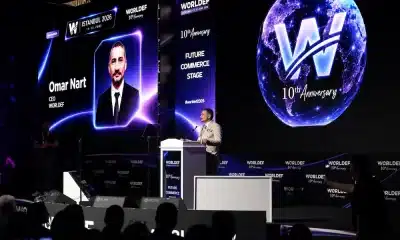

WORLDEF ISTANBUL 2026 Welcomed 22,000 Visitors From 82 Countries
Bringing together 22,000 visitors from 82 countries, WORLDEF ISTANBUL 2026 reinforced Türkiye’s position as a regional hub for e-commerce, retail,...
Against the Current: How Turkey Defies Europe’s Investment Crisis
Yeşim Çevik | trbusiness.de Germany Representative Europe is sliding into a tangible crisis of confidence among international major investors. While...