
New Generation Jobs
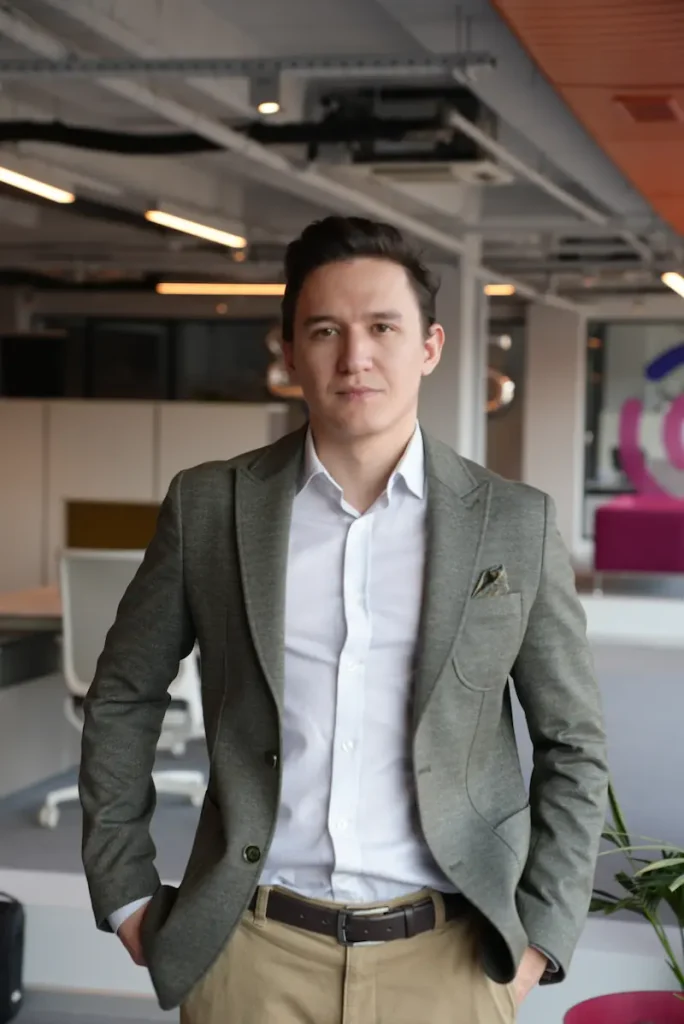
Metehan Türkay: Real life is much funnier than my content
On one side, B2B sales processes for over 140 companies; on the other, social media content poking fun at the clichés of the startup world. We spoke with Metehan Türkay about technology, sales, entrepreneurship, and humor in the business world.


Interview: Yeşim Çevik
In this interview with Metehan Türkay, we discuss B2B sales, artificial intelligence, expanding into Europe, and entrepreneurship. However, the most entertaining part of our conversation was Metehan’s perspective on the business world through the lens of humor.
Metehan knows corporate world clichés from the inside out and turns them into hearty laughs on social media. His statement, which we also chose as our title, sums it all up: “Real life is much funnier than my content.”
I am convinced that this conversation is not only exciting from a sales and technology standpoint, but will also bring joy to anyone who wants to take a lighthearted look at the business world.
Metehan, tell us a bit about yourself.
I am a modest entrepreneur. I deal with startups, SMEs, and B2B companies in general. My main task is generating sales opportunities for them.
On the other hand, I write and draw every now and then let’s just say I make people laugh on social media. :)
Brands usually expand their sales team to win new customers. You, on the other hand, downsize it with CoreMagnet. How did the idea for CoreMagnet come about?

Yes, the sales world has changed like everything else. There is much more technology involved, and processes need to be rethought. Customer behavior has also shifted: buyers are more impatient and hold more leverage. Especially with the development of AI, we live in a world where creating things has become easier, but selling has become harder.
The classic reflex is: when sales stall, you hire more people. But if you look at a salesperson’s workday, they spend most of their time not on sales calls, but on research, list building, writing emails, follow-ups, and CRM maintenance. So when you hire new employees, you usually aren’t buying additional sales capacity, you’re buying muscle power for operational burden.
“AI solved one problem while creating another; that’s the real challenge on the ground today.”
Today, a large portion of this load can be covered by systems. Instead of reducing the number of sales reps, we deploy them right where human input really makes a difference: in negotiations and closing. As a result, a smaller team achieves the same volume as a large team used to. That is precisely the solution we wanted to create.
We founded CoreMagnet in 2023 as two friends one living in Istanbul and the other in Amsterdam. It wasn’t actually a project we were desperately trying to start, but rather something we simply couldn’t let go of. I come from the corporate world, and my partner at the time, Burhan, had a startup close to an exit. We were closely monitoring AI developments and had ideas for B2B sales that excited us tremendously. We also had the ability to quickly turn these ideas into prototypes and simple products.
Back then, we saw a clear picture: in the Turkish SME and startup segment, there was a significant efficiency gap in B2B sales. Tools and processes that were standard for me in the corporate world and for Burhan in the tech firm were either not used at all or only half-heartedly applied by similar companies.
Initially, we didn’t have a rigid plan. We knew we wanted to revolutionize sales through technology. We presented the idea to a friend who owned an industrial SME. He was enthusiastic and said: “Whatever ideas you have, test them on us.” So we started our journey with a client before our own concept was even fully developed.
Even those initial prototypes brought enormous value to the company. With that confidence, we set our other projects aside and focused entirely on this.
Since then, we have been developing solutions to optimize B2B sales and have taken over the processes of over 140 companies. Meanwhile, I have completely taken over CoreMagnet, while the partnership with Burhan continues in other projects. Today we work with an established and simplified workflow though we learned in the process that simplification is often the hardest part.
In your opinion, what has AI really changed in B2B sales, and where does the human factor remain indispensable?
AI has reduced execution costs to almost zero. But it hasn’t reduced the cost of doing the wrong thing at all. In that single sentence lies essentially the entire transformation.
Specifically, the following is changing: generating target audience lists, researching companies, understanding responsibilities, drafting 30 different email variations, classifying replies, sending follow-ups on time. Three years ago, that took a team an entire week. Today, it’s an automated system. The preparation done by four people can now be handled by one person in an afternoon and with fewer errors.
The irony: this capability is now available to everyone simultaneously. What allows you to send 10 times more emails also allows your competitor to do the same. Inboxes are overflowing. An opening line that worked three years ago now feels generic because the recipient got four similar emails that same week. AI solved one problem, but created a new one at the same time that is the actual challenge in the market.
Where humans remain irreplaceable:
- Target Audience Selection: AI executes hypotheses cleanly, but cannot judge whether a hypothesis is worth pursuing in the first place. The feeling that “there is potential in this segment” rarely comes from data; it comes from industry experience. The risk: bothering the wrong target group with extreme efficiency is easier than ever today.
- The Message Itself: AI writes grammatically correct, fluent emails. The problem is: correct isn’t enough. You need to know what genuinely annoys your contact, which phrasing turns them off, and which technical jargon no one actually uses in practice. This knowledge sits in the heads of experienced sales reps. Recognizing whether a text hits the mark or is just clean remains pure HUMAN work.
- The Meeting Itself: During a conversation, the buyer evaluates not just the product, but the person across from them. Sensing hesitations, picking up on unstated objections, building trust. Our goal is to get the right person into that room. Trying to automate what happens inside that room is the wrong approach.
In summary: AI has taken over preparation in sales, not decisions. The focus has shifted from doing to selecting. And selecting has always been the harder part.
What do you look at first when a company comes to you? Product, target market, sales team, or existing customer acquisition?
We don’t operate on a rigid checklist; instead, we seek answers to a cluster of questions:
- Who are you selling to? That’s usually what the first conversation is about. We try to understand who the actual buyer is, not just what the product does. A company’s self-perception often diverges from reality here.
- Is the customer aware of the problem? There are three scenarios here: Those who know the problem and are looking for a solution want to know why they should choose you. This is where you get straight to your unique value proposition. Those completely unaware of the problem must first be shown the problem, then proven that they suffer from it, and only then presented with the solution—that is the hardest path. And if the customer already has a set budget and existing suppliers, the question isn’t “Can I convince them?” but “When does a window open for a switch?” (contract renewals, dissatisfaction, etc.).
- How familiar is the market with the product category? This is crucial. If the target audience knows the category, only why us matters. If the category is new, you have to educate the market on the category and request a meeting for two completely different tasks.
- How intense is the competition? If the target audience receives five similar emails a week, yours cannot be the sixth generic one. If there is no competition yet, a different danger looms: catching unprepared customers off guard.
- How large is the market? In a market of 100 companies, you approach every single firm individually and in detail. If you’re addressing hundreds of thousands of firms, you need to find accurate generalizations.
“Companies think they’re making sales, but in reality, they’re simply meeting existing demand.”
If a Turkish company says today: “We want to expand to Europe, but don’t know where to start,” what would be your three most important pieces of advice?
Honestly: first decide whether you are even ready for expansion. We rarely work with companies starting completely from scratch. Going into a foreign market unprepared harms both sides. My advice goes in these directions:
- There is no single “European market”: I ask every company: Which country, which city, which industry, which company size? Germany differs from France. What works in the Netherlands falls flat in Italy. Buying behavior, decision-making paths, price sensitivity, and email etiquette are entirely different.
- Exporting is an infrastructure, not a single decision: This applies to products as well as services. Sales abroad don’t begin with knocking on doors. You have to check the foundation: Is there foreign-language staff for negotiations and quotes? Are certifications, compliance, customs, and logistics settled? Is the pricing structure right? Are there references? If a problem arises, can someone jump on a plane on short notice? If the answer is mostly “no,” the problem isn’t marketing.
- You don’t learn a market from behind a desk: This is the most common mistake. Desk research doesn’t teach you practical language. Which technical terms are unusual, which objections arise in the first ten minutes, and who actually makes the decisions—you only learn this on the ground. A trade fair, field visits, ten real customer meetings: without this experience, every email is based on guesses that usually go wrong.
In summary: No illusions. Going abroad doesn’t solve unresolved problems from your home market, it amplifies them. However, if those three points line up, the rest becomes a solvable technical task.
What surprised you the most about the companies you’ve worked with? How would you complete the sentence: “Companies think they are doing sales, but actually…”?
“…they are actually just servicing incoming demand.”
That surprised me the most. Upon closer inspection at many companies, there is no active sales process, only order processing. The phone rings, quotes are sent, a portion closes. That is functional ordering, but it isn’t sales.
The difference: in real sales, you determine where the demand comes from. In mere order-servicing, you sell whatever happens to walk through the door. The latter doesn’t rule out growth, you can grow like that for years. But when word-of-mouth slows down or the market shifts, you lack the levers to adjust.
“You can’t truly understand the field without going into the field.”
The reason: sales in Turkey is often viewed purely as a matter of talent (“Find a good salesperson, and they’ll handle the selling”). But sales is a discipline, an engineering effort: measurable, repeatable, optimizable. How many contacts were reached, how many replies, how many meetings resulted all of this is measurable. In most companies, these metrics are completely missing.
Let’s move to social media. There we see a completely different Metehan: humorous, entertaining, and very authentic. How do the roles of being a co-founder of a serious B2B tech company and creating funny content complement each other?
My daily work provides the raw material. Due to my job, I meet an extremely high number of founders and executives. And I can honestly say: real life is much funnier than my content. I don’t invent anything, I just frame what I see with exaggeration.
Why the content resonates:
- Message through exaggeration: I don’t tell anyone “don’t do this”; instead, I highlight the absurdity of a situation. The viewer draws their own conclusions. That hits harder than direct advice.
- Industry insiders & easter eggs: Clichés and jargon that everyone from the startup or corporate world knows. They become funny as soon as you place them in the right context.
To be honest, the videos sometimes serve as a personal reminder of who I don’t want to become, or I caricature myself in the monster I’ve occasionally turned into.
“I can be funny in front of the camera, but I usually describe myself as more ‘weird’ than funny.”
Humor also acts as a great filter: it breaks down initial barriers. Business partners already know my relaxed side, we’ve already shared a laugh, the ice is broken before the actual business meeting even begins.
Was there ever criticism along the lines of: “If you do such serious business, why are you making content like this?”
To be honest, I had concerns. Doing B2B sales with startups and corporations on one hand, and posting videos mocking those exact worlds on the other I thought it could backfire.
But the reactions pleasantly surprised me. People don’t want to see know-it-alls anymore. Information is available everywhere via AI in 30 seconds. But when you wrap a message in humor, you connect with people much better.
Not a single client relationship suffered from it. On the contrary: it accelerated relationship-building and strengthened trust, because humor also proves that you understand the subject matter down to the smallest detail.
Social media shows your humorous side. What does Metehan the founder look like behind the camera? What do you struggle with the most?
Anyone who knows me knows that I am constantly at war with myself. My biggest opponent is me.
I am a perpetual seeker. When a topic catches my interest professionally or personally I dive deep into it. Right now, I do MMA four times a week plus morning conditioning. Alongside running a company, that time commitment looks crazy from the outside. But when something grips me, it grips me completely.
I run my business the exact same way: obsessing over a problem, rewriting an email 20 times, or correcting details late at night that hardly anyone will notice. I rarely call myself “funny” more like “peculiar.” But most of my successes have stemmed precisely from that peculiarity.
Who do you recommend for our next interview?
I’m sending you to the Netherlands! :) Yetkin Sağ, Burhan Kocabıyık, or Reşat Volkan Günel take your pick:
- Yetkin was my first boss and client a sharp-minded visionary operating between the Netherlands and Turkey with real stories to tell.
- Burhan is a hyperactive serial founder who successfully sold a startup at a young age and is tirelessly launching new projects.
- Volkan is one of the most colorful characters, a startup investor currently active in projects surrounding physical AI. If you say hello to him, you’re guaranteed to leave the conversation smarter and with more energy.
All three are fantastic personalities and top interview recommendations!




Metehan Türkay: Real life is much funnier than my content
On one side, B2B sales processes for over 140 companies; on the other, social media content poking fun at the...


Aslı Gümüşel: Looks sell the first bottle. The product sells the second.
Aslı Gümüşel, who has expanded Ashley Joy into 15 countries, spoke to Trbusiness.de about her entrepreneurial journey, the invisible hurdles...
Türkiye Launches AI Revolution: 1 Trillion TL Investment in the Future of Technology
Yeşim Çevik | trbusiness.de Germany Representative Looking at the global startup and venture capital scene, I see a clear picture:...

A Timeless Experience in the Heart of the City
Abdullah Şancı, General Manager of Ramada by Wyndham Istanbul Old City, spoke with trbusiness.de about the changing dynamics of Istanbul...
AI in Logistics: Turkish AI Startup Raises $3.2 Million
Yeşim Çevik | trbusiness.de Germany Representative Founded in 2025, Munich-based startup 5U AI has raised more than €2.7 million ($3.2...
Why Does the Best Offer No Longer Win?
Onur Kurtay | Founder of Nexon Global Strategy Office For years, there was a fixed equation in the minds of...
Global Expansion: Timing Decides Everything
Yeşim Çevik | trbusiness.de Germany Representative Why international expansion requires more strategy than courage “We are entering the US market...


Türkiye Higher Education Employment Indicators 2025: Medicine and Aviation Lead Job Market Success
New official employment data reveals Türkiye’s top-paying university degrees, fastest-hiring career sectors, and graduate job market trends for 2025.


“Technological Transformation is No Longer Measured in Years, but in Months”
Celalettin Kayahan, Board Member of TSMC Holding, speaks to trbusiness.de about his journey from the textile industry to high-tech ventures,...
You Don’t Export to Germany; You Build Systems There
Onur Kurtay | Founder of Nexon Global Strategy Office Germany is the country to which Turkey exports the most. This...